How Far Can Police Radar Detect Speed?
Police radar can detect a vehicle from hundreds of feet to more than a mile away in favorable conditions, but there is no fixed distance. Line of sight, terrain, traffic, and how the officer aims the radar all affect the range.
On this page (9 sections)
- How far can police radar detect speed in normal conditions?
- What changes police radar's detection range?
- Can police radar clock your speed before you see the officer?
- Can a radar detector tell how far away police radar is?
- Can an officer measure speed without continuous radar?
- Does radar range work the same as laser range?
- What do detector alerts actually tell you?
- How should you use a radar detector responsibly?
- What should you remember about police radar range?
Police radar can detect a vehicle from hundreds of feet to more than a mile away in favorable conditions, but there is no fixed distance. Line of sight, terrain, traffic, the radar unit, and how the officer uses it all affect the range.
A radar reading is possible only when the signal reaches the vehicle and returns to the unit clearly enough to measure. That distance can be much shorter when hills, curves, buildings, or other vehicles block the path.
How far can police radar detect speed in normal conditions?
Police radar may measure speed from hundreds of feet to over a mile when the road is open and the radar has a clear path. Treat that as a broad range, not a promise about any particular road or encounter.
Radar units send radio waves toward traffic and use the returning signal to calculate speed. The strength of the return depends on the target, the radar's position, and what lies between them.
A straight, open stretch can give radar a longer path than a winding road with trees and buildings. Traffic also matters: a larger vehicle may return a stronger signal than a smaller one, and multiple vehicles can make it harder to identify which reading belongs to which car.
If you want to understand what a detector can report about that signal, start with what a radar detector does. It can alert to radar energy, but an alert does not reveal an exact distance.
What changes police radar's detection range?
Line of sight and the road environment are the main practical limits. Radar can travel beyond what you can see in some situations, but obstacles and the angle between the unit and vehicle can weaken or block a useful return.
Do hills, curves, and buildings shorten radar range?
Yes. A hill crest, sharp curve, bridge support, or building can obstruct the signal path and reduce the distance at which radar can get a usable reading.
Roadside trees, signs, and barriers may also affect the path, especially when they sit between the radar unit and the target. The specific effect varies with the layout; a clear approach on one road may offer very different conditions from a road nearby.
Does weather affect how far radar reaches?
Rain, snow, and other weather can affect radar signals, but the impact depends on conditions and equipment. Don't assume that bad weather makes radar ineffective or that clear skies guarantee a long range.
A driver should focus on posted limits and road conditions, not try to estimate whether radar can reach a particular stretch. Weather that reduces visibility also gives you less time to react to traffic and hazards.
Does a moving patrol car change the range?
A moving patrol car can measure traffic while both vehicles are in motion, but usable range still depends on the signal path and the unit's operation. The patrol car's movement doesn't create a single predictable detection distance.
Radar can also be used from a stationary position. In either case, the reading depends on the target and the conditions at that moment.
Can police radar clock your speed before you see the officer?
Yes, that can happen when the radar has a clear path before you spot the patrol car. Radar signals can reach around some visual obstructions, and the officer may be positioned outside your direct view.
An officer may also aim the unit at traffic from a roadside position or a moving vehicle. Seeing the patrol car late doesn't mean radar only began reaching you at that moment.
A radar detector may alert when it receives a radar signal, but it can't guarantee advance warning. Some radar use may be brief or aimed at a specific vehicle, leaving little or no earlier signal for a detector to pick up.
Can a radar detector tell how far away police radar is?
No detector can turn signal strength into a dependable distance reading. A stronger alert can mean the signal is closer or less obstructed, but reflections, road layout, radar direction, and the detector's position can also change the strength.
For example, a signal may grow as you approach, then weaken when a building or hill blocks the path. A detector's band and strength indicators can help describe the signal, but they don't pinpoint the officer or the vehicle being measured.
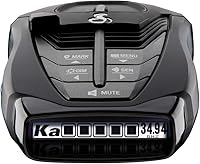
The Uniden R7 shows the band and signal strength for detected signals, with arrows indicating the threat's direction.
Those features provide more information about an alert, but they don't calculate how many feet away the radar unit is. See how K band and Ka band alerts differ for help interpreting common radar alerts.
Can an officer measure speed without continuous radar?
An officer may use radar in ways that give you little warning. If the unit transmits only when aimed at a vehicle, a detector may receive the signal only as the speed measurement is being made.
Some systems also use short radar bursts or other operating modes. A detector's ability to respond can depend on the mode and the timing, so no alert system can promise to warn before every reading.
The Escort MAX 3 offers radar and laser alerts, GPS based filtering, and access to the Defender Database for red light and speed camera alerts. Escort describes its detectors as detection only.
Detection features do not prevent a speed reading, and they don't replace watching the road. For a broader look at detector limits, read whether radar detectors still work.
Does radar range work the same as laser range?
No. Radar and laser use different signals, so their detection patterns differ.
Radar typically covers a broader area, while laser is aimed more narrowly at a specific vehicle.
A laser gun can take a speed reading quickly when it has a clear view. A detector may not alert until the laser is already aimed at your vehicle, because the narrow beam may not reach other cars first.
The Cobra RAD 390 has front and rear laser detection, along with adjustable sensitivity and filtering modes.
Laser detection is not the same as blocking or preventing a speed measurement. Learn more about the difference in whether radar detectors pick up lidar guns.
What do detector alerts actually tell you?
An alert tells you that the detector received a signal it recognizes, not that police have measured your speed. The band and strength can provide clues, but they don't identify the radar unit's exact location or target.
False alerts can come from sources such as automatic doors or vehicle systems. GPS based filtering can help reduce repeat alerts at familiar locations, but filtering does not make every alert a confirmed police signal.
The R7 can use GPS to remember and mute common false alerts along regularly driven routes. That function helps manage repeat alerts; it does not extend police radar's range or confirm the source of every signal.
How should you use a radar detector responsibly?
Use a detector as an awareness aid, not as a reason to speed or a substitute for safe driving. Keep your attention on the road, follow posted limits, and leave room to respond to changing traffic.
Laws on radar detectors vary by location and vehicle type. Check the rules where you drive with our guide to where radar detectors are illegal, and review how to use a radar detector legally before installing or using one.
What should you remember about police radar range?
Police radar can sometimes measure speed from more than a mile away, but distance changes with line of sight, terrain, traffic, and radar use. No detector alert can reliably tell you how far away the officer is or guarantee warning before a reading.
Choose a detector based on the alerts and filtering features you want, rather than a claim that it will reveal a fixed detection distance. For models marketed around highway detection, compare the options in our guide to long range radar detectors.
Frequently asked questions
How far away can police radar clock a car?
Police radar may measure a vehicle from hundreds of feet to more than a mile in favorable conditions, but no single distance applies to every stop. The radar unit, angle, line of sight, terrain, traffic, and target vehicle can all affect how far away a usable reading is.
Can police radar detect speed around a curve?
A curve can block or weaken the radar path, so an officer generally needs a usable line of sight to the target. The exact effect depends on the road and surroundings; hills, buildings, and dense roadside objects can also limit what the beam reaches.
Does a radar detector tell you how far away police are?
A detector usually reports a radar signal's band and strength, not a reliable distance to the officer. Signal strength can change with obstructions, radar direction, reflections, and the detector's position, so don't use an alert as a measurement of how far away a patrol car is.
Can a radar detector warn you before police radar measures your speed?
Sometimes, if the radar is transmitting and the signal reaches your detector before your vehicle is measured. An officer may wait to transmit or aim at one vehicle, so an alert is never guaranteed to arrive before a speed reading.